1. Common Camunda Use Cases
Camunda is a process orchestration platform: you draw a business process in BPMN, deploy it, and the engine runs it, waiting for people, calling services and keeping the state. Background: BPMN and Workflow Engines. The rest of this section: BPMN Modelling Guide, DMN and FEEL and the Camunda 8 notes.
What it is used for
Technical use cases
| Use case | What the engine does |
|---|---|
| Human workflow automation | Routes tasks to people, tracks deadlines, escalates when late |
| Microservices orchestration | Calls services in order, retries failures, handles errors and compensation |
| RPA bot orchestration | Starts and supervises robots, passes data in and out |
| Decision automation | Evaluates business rules (DMN tables) inside a process |
| Document management | Moves documents through review, approval and archiving |
Business processes
| Process | Typical steps |
|---|---|
| Customer onboarding and data management | Collect details, verify identity, create accounts, welcome |
| Order management | Receive, check stock, charge payment, ship (see the order example in the BPMN guide) |
| Claims management | Register claim, assess, investigate, decide, pay |
| Loan origination | Application, credit check, underwriting, offer, signing |
| Risk management and underwriting | Score risk with rules, refer exceptions to a person |
Why use an engine instead of code
flowchart LR
    A["Process in code: state in your DB, timers in cron, retries by hand"] --> B["Hard to see, change and audit"]
    C["Process in BPMN: engine keeps state, timers, retries, history"] --> D["Diagram = documentation = executable"]
- One diagram everyone reads: business and developers discuss the same model.
- Long-running by design: waits of days or weeks survive restarts.
- Built-in reliability: retries, timeouts, incidents, audit trail.
- Visibility: see every instance, where it is stuck and how long steps take.
- Not a good fit for very short, purely technical request/response logic, or one-off scripts.
Code and deploy in your preferred language
Workers are ordinary programs that do the work for a service task. Use Java, C# (.NET), Python, Node.js (TypeScript), Go, Ruby or anything that can call the API. How: Writing Job Workers.
Where it runs
| Platform | Notes |
|---|---|
| Docker Compose | Local or small self-managed setups |
| Kubernetes | Production self-managed (Helm charts), see Orchestration Platforms |
| SaaS | Camunda's hosted service, nothing to operate |
| Camunda 8 Run | A single download that runs everything locally: Running Camunda 8 Locally |
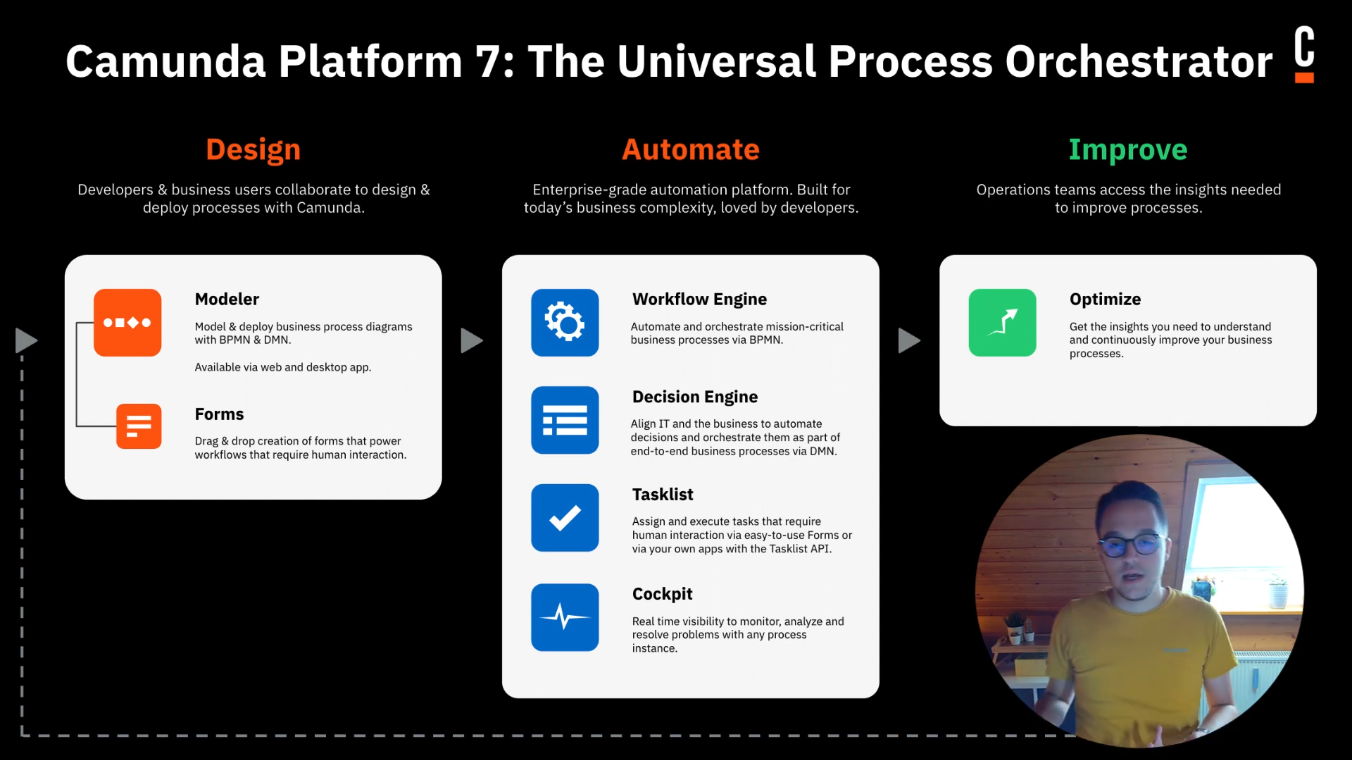
Camunda 7 and Camunda 8: universal process orchestrator
Camunda 7 (engine embedded in a Java application, relational database):
Camunda 8 (Zeebe engine as a separate, horizontally scalable service):
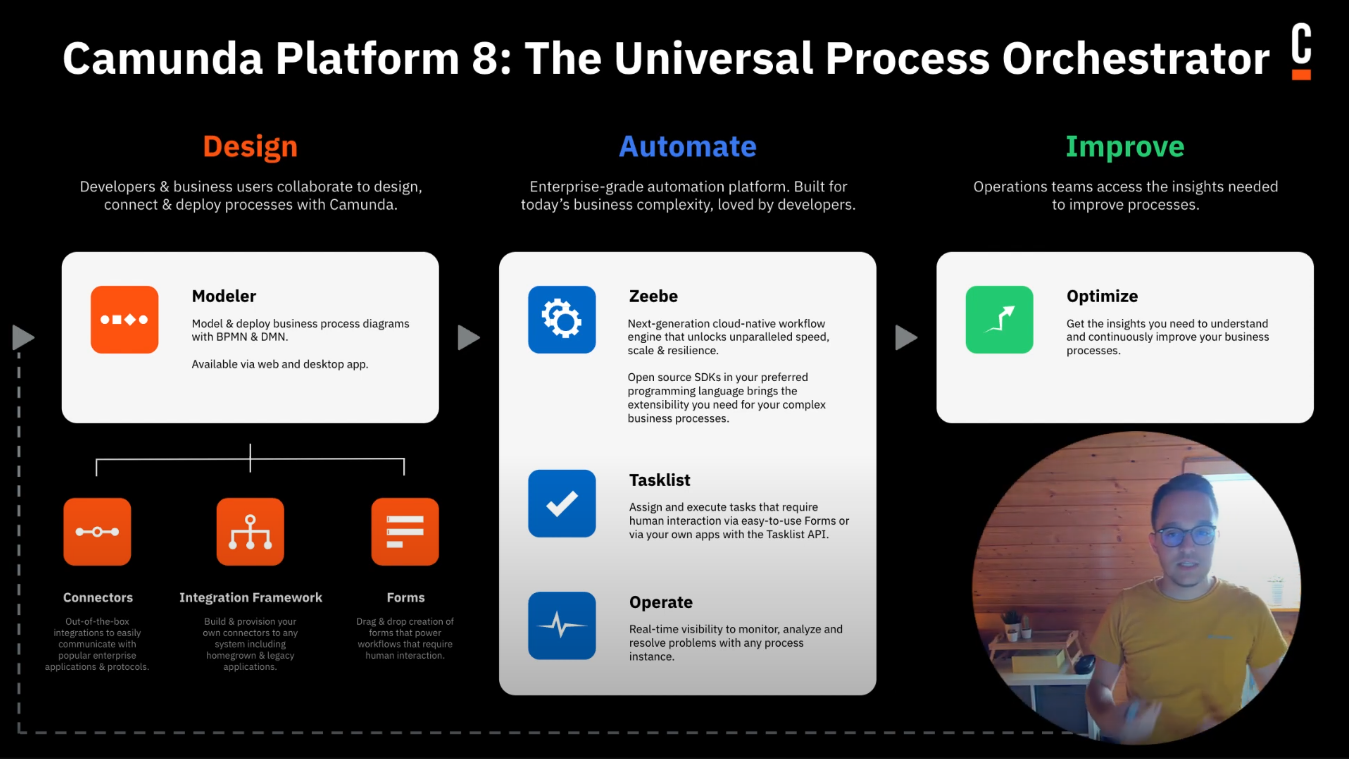
Comparison and notes on migrating: Camunda 8 Architecture.